

About the Author: Sonal Macwan — Certified Financial Professional (CA), [License Number: 4421528] focused on retirement planning, life insurance basics, and long-term financial readiness for mid-career adults.
Education builds clarity. Personalized planning provides direction.
When considering life insurance, one of the biggest questions people ask is: “How much coverage do I really need?” The answer isn’t one-size-fits-all. But the DIME Method is a smart, easy-to-remember formula to help you get a reliable estimate based on your actual life responsibilities.
Quick Answer: How Much Life Insurance Do Most People Need?
Most families need enough life insurance to cover:
- Final expenses (funeral + medical bills)
- Income replacement
- Mortgage or rent
- Debt payoff
- Kids’ education
- Spouse support
- Emergency savings
- Future goals
- Taxes (sometimes)
- Existing savings and employer benefits deducted
A typical range for many households is 10 to 15 times annual income, but that’s only a starting point.
The more accurate way is doing a real needs-based calculation. Following simple, DIME method based interactive calculator will help you find out your financial needs. Give it a try, it’s easy and fun!
Easy Life Insurance Need Calculator [DIME Method]
Your Estimated Life Insurance Need (DIME)
This is a simplified estimate. Review with a licensed financial professional.
According to the Certified Financial Planner Board of Standards (CFP Board), conducting a comprehensive needs analysis is a core component of responsible financial planning because it ensures recommendations are suitable, client-specific, and aligned with long-term goals rather than product-driven sales strategies.
🧾 Example Breakdown: How Much Coverage Is Enough?
Let’s say you’re evaluating your life insurance needs. Here’s what you’d include under each DIME category:
Why 40-somethings are buying life insurance more than ever now?
🔶 Debt
- Credit Cards: $8,000
- Auto Loan: $12,000
- Final Expenses (funeral, burial, etc.): $15,000
➤ Total Debt = $35,000
🔵 Income
- You earn $66,000 per year.
- Your spouse doesn’t depend on your income, so you choose 0 years of income replacement.
➤ Total Income Replacement = $0
🟢 Mortgage
- Outstanding mortgage balance: $250,000
➤ Mortgage = $250,000
🟠 Education
- Two children × $100,000 each = $200,000
➤ Education = $200,000
✅ Final Insurance Need:
$35,000 (Debt) + $0 (Income) + $250,000 (Mortgage) + $200,000 (Education) = $485,000
So, you would look for a policy that covers at least $485,000.
🧠 Why This Matters
Without life insurance, your loved ones could be left facing bills, mortgage payments, and college tuition without your financial support. The DIME Method ensures nothing is left out—and gives your family a safety net when they need it most. This DIME method is used by many financial industry leaders, such as investopedia , insurance-marketing agents and HGI group.
What Is a Financial Needs Analysis (FNA)?
A Financial Needs Analysis is a structured way of calculating how much money your family would need if your income disappeared due to death.
Instead of guessing, it answers questions like:
✅ Will your spouse still be able to pay the mortgage?
✅ Will your kids still go to college?
✅ Will debt be wiped out or transferred?
✅ Will your family have enough time to grieve without financial pressure?
A proper FNA turns those emotional concerns into real numbers.
If you want an official consumer-friendly guide, the California Department of Insurance also explains how to define your life insurance needs in a clear step-by-step format. You can read it here:
California Department of Insurance guide to defining your life insurance needs.
Why Life Insurance Calculations Matter (More Than People Think)
Life insurance isn’t just about burial costs. It can also protect:
- Your children’s future lifestyle
- Your spouse’s retirement
- Your business obligations
- Your family’s home stability
- Outstanding debts that don’t disappear
The goal is not to make your family “rich.” The goal is to prevent them from being financially destroyed.
The 3 Most Common Methods to Calculate Life Insurance Needs
Let’s break down the three main methods people use.
1) The “10x Income Rule” (Fast but Not Precise)
This is the simplest method:
Annual income × 10 = estimated life insurance coverage
Example:
If you earn $80,000/year → $80,000 × 10 = $800,000
Pros:
- Very quick
- Easy to remember
- Useful as a starting estimate
- Best for: quick planning, early estimates.
Cons:
- Doesn’t consider debt, kids, mortgage, savings, or spouse income
- Can overestimate or underestimate by a lot
2) The DIME Method (Most Popular Needs-Based Formula)
DIME stands for:
D – Debt
Include credit cards, car loans, personal loans, medical bills.
I – Income
Multiply your annual income by the number of years your family would need support.
M – Mortgage
Add remaining mortgage balance (or expected housing cost support).
E – Education
Estimate future college costs for children.
Example DIME Calculation
Let’s say:
- Debt: $25,000
- Income: $75,000 × 15 years = $1,125,000
- Mortgage: $280,000
- Education: $100,000
Total = $1,530,000
Now subtract savings/assets later (we’ll cover that below).
Why DIME is so effective:
It forces you to think about real responsibilities. Use following, interactive , simple storytype calculator to find out your own financial needs::
Your Estimated Life Insurance Need (DIME)
This is a simplified estimate. Review with a licensed financial professional.
3) Full Financial Needs Analysis (Most Accurate Method)
This is the method used in professional financial planning. Instead of using broad assumptions, you calculate:
- Immediate cash needs
- Long-term income needs
- Special goals
- Inflation impact
- Existing savings, investments, and benefits
This gives the most realistic coverage number.
The Best Life Insurance Coverage Range (Simple Rule)
Once you calculate your number, place it into a safe range:
- Under $250,000: usually only final expense/basic debt
- $250,000–$500,000: small family support
- $500,000–$1 million: common middle-income households
- $1 million–$2 million: families with mortgage + kids
- $2 million+: high income earners, business owners, large goals
Common Mistakes People Make When Calculating Life Insurance Needs
These errors are extremely common:
❌ Only covering funeral costs
That leaves your spouse with mortgage and income loss.
❌ Forgetting childcare costs
Childcare can easily become a second mortgage.
❌ Not accounting for inflation
$70,000 today will not feel like $70,000 in 15 years.
❌ Assuming debt disappears
Some debts may transfer or affect your estate.
❌ Relying only on employer life insurance
Employer policies may:
- not be portable
- be too small (often 1x salary)
- disappear if you leave the job
Life Insurance Needs for Different Life Stages
Your coverage should change as life changes.
Life Insurance Calculator Checklist (Copy + Save)
Use this simple checklist:
✅ Funeral/Final Expenses: $________
✅ Debt Total: $________
✅ Mortgage Payoff: $________
✅ Income Replacement: $________
✅ Childcare Costs: $________
✅ Education Fund: $________
✅ Emergency Savings Cushion: $________
Total Needs: $________
Now subtract:
✅ Savings/Investments: $________
✅ Retirement Accounts: $________
✅ Existing Life Insurance: $________
✅ Employer Coverage: $________
Total Assets: $________
📌 Recommended Life Insurance = Total Needs – Total Assets
How Often Should You Recalculate Life Insurance Needs?
You should redo your needs analysis whenever life changes:
- marriage
- new baby
- new mortgage
- income increase
- divorce
- starting a business
- buying rental property
- paying off major debts
A good habit is reviewing it every 2–3 years.
Is Life Insurance Part of Financial Planning?
Yes. Life insurance is not just “insurance.”
Life insurance explained: types, benefits, costs, and how to choose the right policy
It’s part of a bigger plan that includes:
- budgeting
- emergency fund planning
- retirement planning
- debt elimination
- wealth building
- protecting your family’s financial foundation
If you’re building wealth, you also need to protect it.
Try out this calculator for FNA (simple version)
It answers one big question: “If someone in the family dies today, how much money should be in place so the survivors can keep life on track?”
Financial Need Analysis
Income Replacement & One-Time Needs
Existing Assets & Benefits
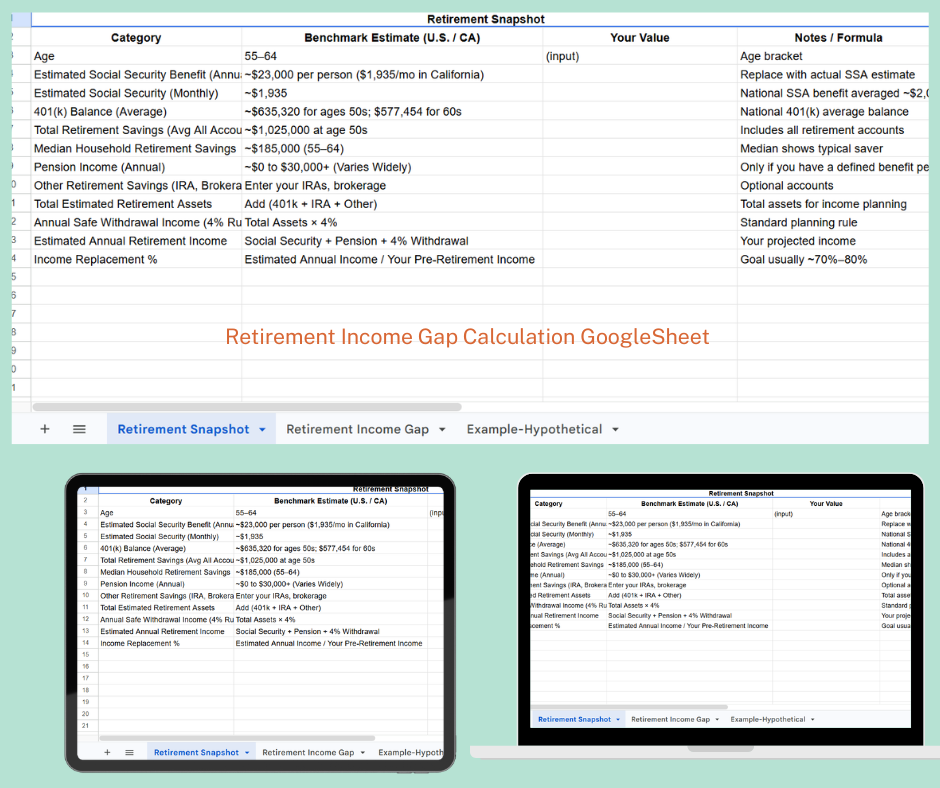
Retirement Income Gap
Emergency Fund Target
🧮 What Is the DIME Method?
DIME stands for Debt, Income, Mortgage, and Education—four key areas where your family would need financial support in your absence.
This calculator follows the DIME method—Debt, Income, Mortgage, Education—to estimate how much life insurance a California family should carry.
It adds (1) outstanding debts and final expenses, (2) the present value of the income your household would need for a chosen number of years, (3) the remaining mortgage balance you want paid off, and (4) education funding for kids. Then it subtracts what you already have—savings/investments, existing life insurance, and any survivor benefits (e.g., Social Security)—to arrive at a clean coverage target (rounded to the nearest $1,000). The present-value math uses a real discount rate (expected return minus inflation), so you’re funding tomorrow’s needs with today’s dollars realistically.
Term Life Insurance explained for beginners and first-time buyers
Example family (California)
- Parents: married couple, both age 50
- Kids: ages 18 and 16
- Mortgage balance: $625,000
- Goal: protect lifestyle until retirement age (say, 67 → 17 years left)
- Annual income to replace: $180,000 (combined)
- Assumptions used by the tool:
- Long-run inflation 2.5%
- Net investment return 5.0%
- Final expenses $15,000 (typical planning number)
- College fund target $160,000 total (e.g., $80k each)
- Savings already earmarked $200,000
- Current life insurance $250,000
- Survivor benefits (Social Security): $0 in the base run (we’ll show an optional tweak below)
If you are in mid-career stage of the life, it is time to consider retirement planning. Find out different types of life insurances, consumer rights and shopping tips from official resources like the California Department of Insurances. Check and verify a license when you talk to a financial planner.
Step-by-step
1) Capital to replace income (17 years): ≈ $2,480,000
(using the calculator’s present-value math)
2) One-time expenses:
- Mortgage & debts: $625,000
- College fund: $160,000
- Final expenses: $15,000
Subtotal: $800,000
3) Subtract resources:
- Savings + current life insurance: $450,000
4) Suggested life insurance need (rounded):
$2,480,000 + $800,000 − $450,000 = ≈ $2,831,000
So this family would target about $2.83 million of total coverage across the household.
To better understand flexibility, cash value growth, and long-term planning benefits, it helps to review how universal life insurance works within a broader financial strategy.
Optional survivor-benefit adjustment
If you expect, say, $18,000/year of Social Security survivor benefits for ~6 years (until the youngest turns 18), the present value is about $99,000. Subtracting that would lower the need to ≈ $2.73 million.
What a family may receive and how to apply for it? This is an official guide to look for.
Explore Financial Planning Resources
Financial clarity improves when you have the right tools and explanations in one place. Explore our curated resources to better understand life insurance, retirement planning, and wealth-building strategies—designed to support informed, confident financial decisions.
Visit the Resources Page →Still thinking why buy a life insurance?
This is an educational estimate. For final decisions, review with a licensed California agent/planner and consider health, insurability, and budget.
Frequently Asked Questions (FAQ)
How much life insurance do I need if I have no debt?
You may still need income replacement and final expenses. Debt isn’t the only reason for life insurance.
Should I include my 401(k) as an asset to subtract?
Yes, but carefully. Retirement accounts may have taxes or penalties depending on withdrawal type.
Is $500,000 life insurance enough?
It depends on your income, family size, mortgage, and goals. For many families with children, $500,000 may not fully replace income.
Is employer life insurance enough?
Usually no. Most employer plans are 1x salary, which often doesn’t cover long-term family needs.
🧑💼 How a Financial Planner Can Help
While the DIME Method offers a great starting point, a licensed financial planner can help you:
- Factor in inflation and interest rates
- Balance term vs. whole life insurance
- Integrate your policy with other assets and retirement plans
- Adjust coverage over time as your income, debts, or family changes
A good planner will not “sell” you a product—they’ll build a protection plan tailored to your values and goals. Find out the best licensed financial planner in your area using this tips.
💡 Your Money, Your Future — Get Expert Help Today
Making financial decisions about retirement, insurance, or estate planning can feel overwhelming. That’s why we’ve made it easier than ever to get professional guidance. With our simple Financial Solution Widget, you can connect instantly with a vetted financial.
Connect With An Advisor📌 Final Tip
Even if you’re not ready to purchase a policy today, knowing your DIME number gives you clarity. You’re not guessing—you’re planning with purpose. Planning becomes easier when you can use simple, free planning tools.
The right life insurance number isn’t based on guesswork. It’s a trusted process build by the industry and legal governing bodies.
A real financial needs analysis helps you protect what matters most: your family’s home, income, and future.
If you want a fast shortcut, use the DIME method.
If you want accuracy, calculate:
📌 Debt + Mortgage + Income Replacement + Education + Emergency Cushion – Savings
That’s your real number. The Best Life Insurance Amount Is the One That Protects Your Family’s Lifestyle
What is Google Workspace?
Google Workspace is a cloud-based productivity suite that helps teams communicate, collaborate and get things done from anywhere and on any device. It’s simple to set up, use and manage, so your business can focus on what really matters.
Watch a video or find out more here.
Business email for your domain
Look professional and communicate as you@yourcompany.com. Gmail’s simple features help you build your brand while getting more done.
Access from any location or device
Check emails, share files, edit documents, hold video meetings and more, whether you’re at work, at home or on the move. You can pick up where you left off from a computer, tablet or phone.
Enterprise-level management tools
Robust admin settings give you total command over users, devices, security and more.
Sign up using my link Google Workspace Referral Link and get a 14-day trial, and message me to get an exclusive discount when you try Google Workspace for your business.
Start Your Free 14-Day TrialThis content is provided for educational and informational purposes only and is not intended as financial, legal, tax, or investment advice.