
- 1. The "3x Salary" Benchmark: Why the Rule of Thumb often Fails in the Bay Area
- 2. Exploiting the SECURE 2.0 Act: Insider Wealth Levers for 2026
- 3. Beyond the 401(k): Diversifying Your Strategic "Tax Buckets"
- 4. The 50/30/20 Rule: A Professional’s Framework for High Income Earners
- 5. The "Magic Number" and the 4% Rule
For many professionals in their 40s and 50s, retirement planning has shifted from a “someday” conversation to a high-stakes calculation.

About the Author: Sonal Macwan — Certified Financial Professional (CA), [License Number: 4421528] focused on retirement planning, life insurance basics, and long-term financial readiness for mid-career adults.
Education builds clarity. Personalized planning provides direction.
Recent data from the Northwestern Mutual 2026 Planning & Progress Study reveals that Americans now believe they need a staggering $1.46 million to retire comfortably—a 15% jump from just a year ago.
As a financial professional, I see the same pattern: mid-career experts have the income, but they lack the structural “architecture” to turn that income into lasting freedom. If you are in the “sandwich generation”—managing career peaks while balancing family needs—these are the eye-opening facts and wealth-building strategies you need to master today.
1. The “3x Salary” Benchmark: Why the Rule of Thumb often Fails in the Bay Area
A standard industry guideline suggests that by age 40, you should have roughly three times your annual salary saved for retirement. If you earn $150,000, your target nest egg today should be nearing $450,000.
The Professional Reality Check: In my practice, I’ve found that this “one-size-fits-all” number rarely accounts for the complexity of mid-career life. For many professionals I work with, the “3x rule” feels discouraging because it ignores the heavy lifting they are doing right now—balancing high-interest mortgages, children’s education, and the rising costs of living.
Expert Insight: If you’re behind this benchmark, don’t view it as a failure—view it as a call for “Structural Architecture.” Most of the successful portfolios I manage didn’t start with a massive lump sum; they were built by identifying “leaks” in cash flow and redirecting them into high-yield, tax-advantaged vehicles.
The Power of Small Calibrations: Even if you are starting later than planned, the “Architecture of Retirement Saving” suggests that small adjustments now have a massive trailing effect. According to Fidelity Investments, a 35-year-old earning $60,000 who increases their contribution by just 1% could see an additional $110,000 by age 67 due to the power of compounding.
2. Exploiting the SECURE 2.0 Act: Insider Wealth Levers for 2026
The legislative landscape has shifted in favor of the proactive saver. In my experience, most clients are aware that the SECURE 2.0 Act exists, but few are “weaponizing” its specific features to bridge their retirement gap. Here is how I suggest my clients look at these 2026 updates:
The HSA “Triple Threat” (High-Value Wealth Vehicle)
Many mid-career professionals I consult with still view the Health Savings Account (HSA) as a rainy-day fund for doctor visits. In reality, it is a “Stealth IRA” and arguably the most powerful tax-advantaged tool in the U.S. tax code.
- Triple Tax Advantage: You receive an immediate tax deduction on contributions, the growth is tax-deferred, and withdrawals for qualified medical expenses are 100% tax-free.
- The 2026 Strategy: For 2026, individuals can contribute up to $4,400 ($8,750 for families). I often advise clients to pay for current medical expenses out-of-pocket (if cash flow allows) and let the HSA remain invested in the S&P 500 or diversified ETFs. This transforms the account into a dedicated healthcare nest egg for retirement.
Next Read : $884k Reality : How Retirement in California hits women harder
Enhanced Catch-Up Contributions: The Late-Stage Surge
If you are between the ages of 60 and 63, 2026 marks a pivotal opportunity. SECURE 2.0 has increased the 401(k) catch-up limits significantly for this specific age bracket.
Professional Observation: I’ve seen this “late-stage surge” save retirement plans that were otherwise trending toward a shortfall. By maximizing these specific catch-up provisions, you aren’t just saving more; you are drastically reducing your Taxable Income during your peak earning years.
3. Beyond the 401(k): Diversifying Your Strategic “Tax Buckets”
In my years of financial planning, I’ve observed a common vulnerability: professionals who are “wealthy on paper” but restricted by tax liability. Relying solely on a workplace 401(k) is a risk because it leaves you exposed to future tax hikes. True wealth building for mid-career professionals requires Tax Bucket Diversification.
💰How to Build Tax-Free Retirement Income with IUL (2026 Guide)
The Three Pillars of Tax Efficiency
To protect your retirement income from the “tax bite,” I guide my clients to distribute assets across three distinct buckets:
- Tax-Deferred (The Traditional Baseline): This includes your standard 401(k)s and IRAs. While great for immediate tax breaks, every dollar withdrawn in retirement is taxed as ordinary income.
- Tax-Free (The Roth Strategy): Utilizing Roth IRAs and Roth 401(k)s allows you to pay taxes now at a known rate to enjoy 100% tax-free growth and withdrawals later.
- Tax-Advantageous (The Protection Layer): This is where specialized life insurance products like Indexed Universal Life (IUL) or Fixed Indexed Annuities (FIAs) come into play.
The Role of Annuities and IUL in a 2026 Portfolio
One of the most frequent questions I receive is how to guarantee income without market volatility. This is where Fixed Indexed Annuities serve as a “custom roadmap.”
Professional Perspective: I often leverage annuities for clients who are within 10 years of retirement. They provide a “floor” to prevent downside losses while allowing for market-linked growth. According to data from the North American Company for Life and Health Insurance, these vehicles are essential for the 48% of Americans who fear outliving their savings.
4. The 50/30/20 Rule: A Professional’s Framework for High Income Earners
Effective budgeting isn’t about restriction; it’s about intentional allocation. In my practice, I find that mid-career professionals often fall victim to “Lifestyle Creep”—where expenses rise naturally alongside salary increases, stalling your wealth-building engine.
To combat this, I recommend an “Aggressive Allocation” version of the NerdWallet 50/30/20 framework, specifically tailored for those in peak earning years:
- 50% for Essential Needs: This covers your mortgage, high-value insurance premiums, and utilities. For high-earners, the goal is often to keep this under 50% to maximize investment capital.
- 30% for Lifestyle & Wants: Travel, dining, and hobbies. By defining this bucket, you give yourself “permission to spend” without the guilt of depleting your future security.
- 20% (Minimum) for Wealth Building: This is your engine. For my clients aiming for an early or “phased” retirement, we often aim to push this to 30% or 40% by redirecting bonuses and vested RSUs into diversified portfolios.
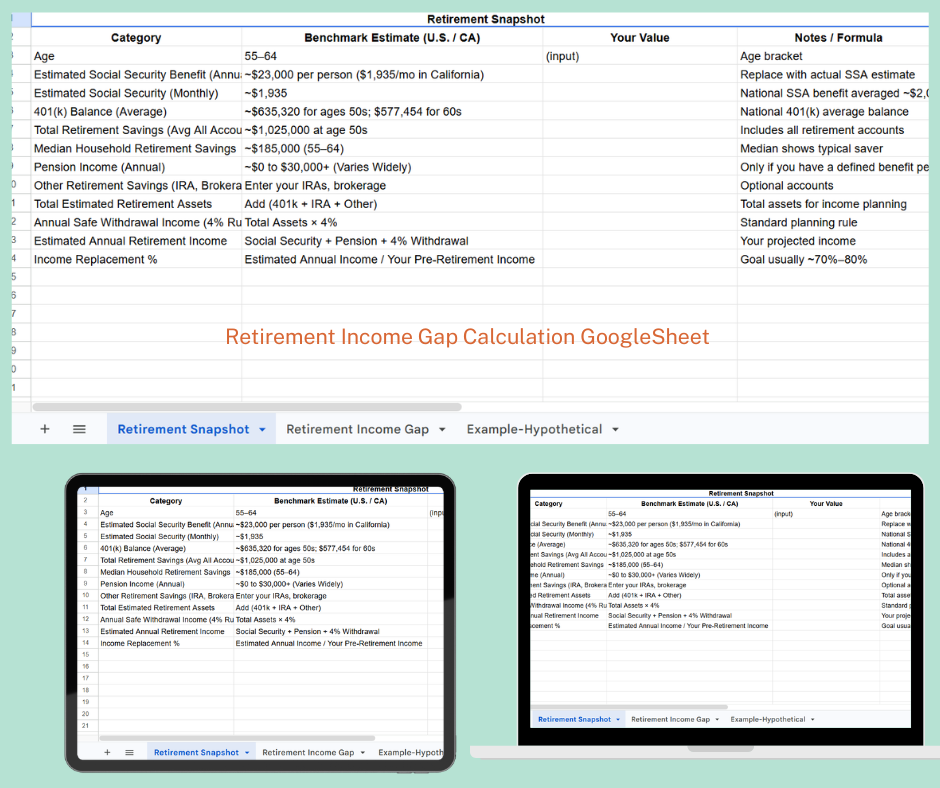
Expert Observation: I’ve seen many Bay Area families struggle with the “Needs” bucket due to housing costs. The key is to treat your Savings as a “Non-Negotiable Need.” By automating your contributions to your brokerage and retirement accounts, you ensure that wealth building happens before lifestyle spending occurs.
5. The “Magic Number” and the 4% Rule
If the $1.46 million figure feels daunting, remember the 4% Rule. This suggests you can withdraw 4% of your total nest egg in your first year of retirement (adjusted for inflation thereafter) with a high probability of the money lasting 30 years. To generate a $60,000 annual income, you need a $1.5 million portfolio.
What is Google Workspace?
Google Workspace is a cloud-based productivity suite that helps teams communicate, collaborate and get things done from anywhere and on any device. It’s simple to set up, use and manage, so your business can focus on what really matters.
Watch a video or find out more here.
Business email for your domain
Look professional and communicate as you@yourcompany.com. Gmail’s simple features help you build your brand while getting more done.
Access from any location or device
Check emails, share files, edit documents, hold video meetings and more, whether you’re at work, at home or on the move. You can pick up where you left off from a computer, tablet or phone.
Enterprise-level management tools
Robust admin settings give you total command over users, devices, security and more.
Sign up using my link Google Workspace Referral Link and get a 14-day trial, and message me to get an exclusive discount when you try Google Workspace for your business.
Start Your Free 14-Day TrialEye-Opening Fact:
Nearly 72% of Americans now plan to retire “on their own terms,” which often includes a “phased retirement” or gig work. Wealth building isn’t just about stopping work; it’s about having the option to choose how you spend your time.
Final Thoughts: Mastering Your Wealth Building Retirement 2026 Strategy
As we have explored, achieving the $1.46 million “magic number” is less about picking the perfect stock and more about the structural integrity of your financial plan. Success for mid-career professionals in this environment requires a shift from passive saving to active Wealth Building Retirement 2026 strategies.
By maximizing the new SECURE 2.0 catch-up provisions, utilizing HSAs as long-term investment vehicles, and diversifying your tax buckets with annuities and IULs, you can effectively bridge the “reality gap.”
Your 30-Day Wealth Checklist:
- Run the Numbers: Use the 401(k) Calculator to see your current trajectory.
- Audit Your Tax Buckets: Ensure you aren’t 100% “Tax-Deferred.” Aim for a balance of Roth and Tax-Advantaged assets.
- Automate Your “Needs”: Set your 20% wealth-building contribution to trigger the day your salary hits your account.
Professional Note: Wealth building is a marathon, not a sprint. Whether you are in the Bay Area or elsewhere, the best time to calibrate your architecture was yesterday; the second best time is today.
This content is provided for educational and informational purposes only and is not intended as financial, legal, tax, or investment advice.
