
Retirement should be a time of relaxation, freedom, and enjoyment. But for many people, financial uncertainty creates stress instead of peace. That’s why understanding What is Income gap in retirement and how to calculate it is essential for long-term security.

About the Author: Sonal Macwan — Certified Financial Professional, focused on retirement planning, life insurance basics, and long-term financial readiness for mid-career adults. Content is educational, not legal or financial advice.
Education builds clarity. Personalized planning provides direction.
In simple terms, a retirement income gap is the difference between the money you need in retirement and the money you actually receive from guaranteed and investment sources. If you ignore this gap, it can quietly grow—and surprise you later.
Before diving in, it helps to understand the full retirement picture. Our Retirement Planning Pillar breaks down Social Security, income strategies, timelines, and smart decisions so you can retire with confidence.
Let’s break it down step by step.
Introduction to Retirement Financial Planning
Retirement planning isn’t just about saving money. It’s about replacing your paycheck when you stop working.
Why Retirement Planning Matters More Than Ever
People are living longer today. Medical advances and healthier lifestyles mean retirement can last 20–30 years—or even more. That’s a long time to fund without a steady salary.
Without proper planning, savings can run out faster than expected.
The Rising Cost of Living and Longevity Risk
Inflation slowly reduces purchasing power. Something that costs $1,000 today may cost $1,800 or more in 20 years. If your income stays fixed but expenses rise, the gap widens.
Longevity risk—the possibility of outliving your savings—is real. And it’s one of the biggest reasons retirement income gaps occur. Annuity is one of the popular option to avoid the risk of outliving your retirement money.
Understanding the Concept of Income Gap
Before calculating anything, we need to clearly define the concept.
Definition of Retirement Income Gap
A retirement income gap is:
The shortfall between your projected retirement expenses and your projected retirement income.
If your expenses are $60,000 per year but your guaranteed income is only $45,000, your income gap is $15,000 per year.
Simple—but powerful.
Why Income Gaps Happen
Income gaps happen because:
- People underestimate expenses
- They overestimate investment returns
- Inflation reduces buying power
- Medical costs increase
- Retirement happens earlier than planned
Even small miscalculations can compound over time.
Core Components of Retirement Income
To understand your income gap, you must first identify all income sources.
Social Security Benefits
For many retirees, Social Security provides a base income. You can estimate your benefits by visiting the official Social Security Administration website:
https://www.ssa.gov
However, Social Security typically replaces only about 40% of pre-retirement income.
Pension Plans
Traditional pensions are becoming less common. If you’re fortunate to have one, it may provide steady monthly income.
Personal Savings and Investments
This includes:
- 401(k) plans
- IRAs
- Mutual funds
- Stocks and bonds
- Savings accounts
These accounts usually require careful withdrawal planning.
Passive Income Streams
Examples include:
- Rental property income
- Dividends
- Business income
- Royalties
Passive income can significantly reduce your income gap.
Essential Retirement Expenses to Consider
Now let’s talk about the other side of the equation—expenses.
Fixed Expenses
These remain relatively stable:
- Housing (mortgage or rent)
- Property taxes
- Insurance
- Utilities
- Basic groceries
Variable Expenses
These fluctuate:
- Travel
- Entertainment
- Dining out
- Hobbies
Many retirees underestimate lifestyle spending.
Use a budgeting tools that are easy and free to use for income-expense tracking. A income-expense tracker with budgeting and savings goal can help you to manage your finances better.
Healthcare and Long-Term Care Costs
Healthcare often increases with age. According to various studies, medical expenses can become one of the largest retirement costs.
Long-term care, assisted living, or nursing facilities can dramatically increase expenses if not planned for.
Step-by-Step Guide: How to Calculate Your Retirement Income Gap
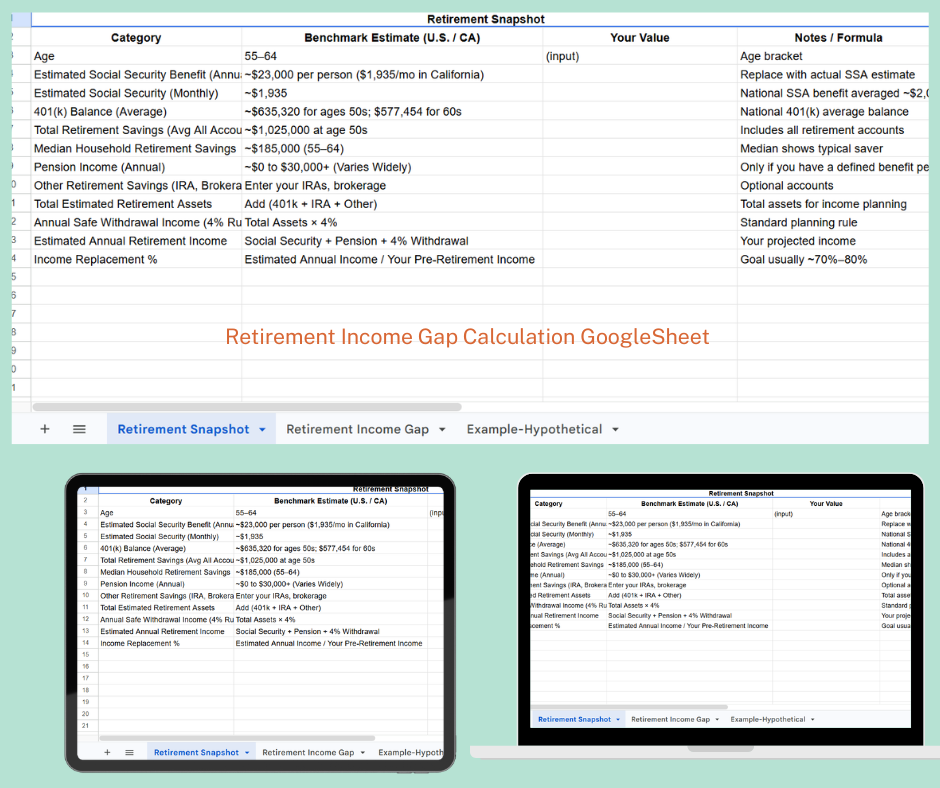
Now we answer the core question: What is Income gap in retirement and how to calculate it in practical terms.
Step 1: Estimate Annual Retirement Expenses
List all projected expenses. A common rule of thumb is needing 70%–80% of your pre-retirement income. However, this varies.
Example:
Annual retirement expenses = $70,000
Step 2: Calculate Guaranteed Income Sources
Add:
- Social Security: $25,000
- Pension: $10,000
Total guaranteed income = $35,000
An official government to calculate social security benefits.
Step 3: Estimate Investment Withdrawals
Financial planners often use the 4% rule:
If you have $500,000 saved:
4% of $500,000 = $20,000 per year
Total retirement income:
$35,000 + $20,000 = $55,000
Step 4: Subtract Income from Expenses
Expenses: $70,000
Income: $55,000
Income Gap = $15,000 per year
That’s your shortfall.
Retirement Income Gap Formula Explained
Let’s simplify the math.
Simple Mathematical Formula
Retirement Income Gap =
Total Annual Expenses – Total Annual Retirement Income
If the result is positive → You have a gap.
If the result is zero → You’re fully funded.
If negative → You have surplus income.
Practical Calculation Example
Let’s imagine Sarah:
- Estimated expenses: $60,000
- Social Security: $22,000
- Pension: $8,000
- Investment withdrawals: $15,000
Total income = $45,000
Income gap = $60,000 – $45,000 = $15,000
Sarah needs to close that $15,000 gap.
Factors That Can Increase Your Retirement Gap
Inflation
Even 3% inflation can double expenses in about 24 years.
Market Volatility
Stock market downturns can reduce portfolio value, limiting withdrawals.
Unexpected Medical Costs
Surgeries, prescriptions, or long-term care can quickly widen the gap.
Smart Strategies to Close the Income Gap
Don’t panic—there are solutions.
Increase Savings Rate
Start saving earlier or contribute more to retirement accounts. Even small increases make a difference over decades.
Delay Retirement
Working just 2–3 extra years can:
- Increase Social Security benefits
- Reduce the number of retirement years
- Allow investments more time to grow
Diversify Investments
Diversification reduces risk. Spread assets across:
- Stocks
- Bonds
- Real estate
- Cash equivalents
Create Passive Income
Rental properties, dividend stocks, or small businesses can provide steady income streams.
Tools and Calculators to Help You Plan
✨ California Women’s Retirement Confidence Quiz ✨
Discover how prepared you are for a secure and empowered retirement.
Online Retirement Calculators
Many free tools estimate retirement income needs. These calculators help simulate different scenarios.
Working with a Financial Advisor
A certified financial planner can:
- Stress-test your retirement plan
- Account for inflation
- Adjust for tax impacts
- Create sustainable withdrawal strategies
Professional advice adds clarity and confidence.
Explore Financial Planning Resources
Financial clarity improves when you have the right tools and explanations in one place. Explore our curated resources to better understand life insurance, retirement planning, and wealth-building strategies—designed to support informed, confident financial decisions.
Visit the Resources Page →Common Mistakes to Avoid
- Ignoring inflation
- Underestimating healthcare costs
- Withdrawing too much too early
- Failing to diversify investments
- Not reviewing plans annually
Avoiding these mistakes keeps your retirement plan on track.
Real-Life Scenario: A Retirement Gap Case Study
Mark and Lisa plan to retire at 65.
They estimate expenses at $75,000 per year.
Income sources:
- Social Security: $40,000
- Pension: $10,000
- Investments: $15,000
Total income: $65,000
Gap: $10,000 per year
By delaying retirement by 3 years and increasing savings, they eliminate the gap completely.
Small changes can create powerful results.
If you want to see how this topic fits into your bigger retirement strategy— including Social Security timing, income planning, and risk management— explore our complete Retirement Planning Guide.
Frequently Asked Questions (FAQs)
1. What is a good retirement income replacement rate?
Most experts recommend replacing 70%–80% of pre-retirement income, though lifestyle goals matter.
2. How often should I calculate my retirement income gap?
At least once per year or after major life changes.
3. Does inflation significantly affect retirement planning?
Yes. Inflation can greatly increase expenses over time.
4. Can part-time work reduce my income gap?
Absolutely. Even modest part-time income can significantly reduce shortfalls.
5. Is the 4% rule always safe?
It’s a guideline, not a guarantee. Market conditions matter.
6. When should I start planning for retirement income gaps?
As early as possible—ideally in your 20s or 30s.
Conclusion: Take Control of Your Retirement Today
Understanding What is Income gap in retirement and how to calculate it gives you clarity and control. Instead of guessing, you now know:
- How to estimate expenses
- How to calculate income
- How to measure the gap
- How to close it strategically
Retirement planning doesn’t have to be overwhelming. With proper calculations, realistic assumptions, and proactive adjustments, you can transform uncertainty into confidence.
Your future self will thank you.
This content is provided for educational and informational purposes only and is not intended as financial, legal, tax, or investment advice.