Retirement planning has long been a core need for people of all ages. Whether you’re just starting your career or approaching the end of your working years, deciding how much to save, when to retire, and how much income you’ll need is complex, stressful, and high-stakes. In recent years, artificial intelligence (AI) has begun transforming how individuals and planners tackle these questions—bringing powerful analytical capabilities to a process that once depended almost entirely on human advisors.
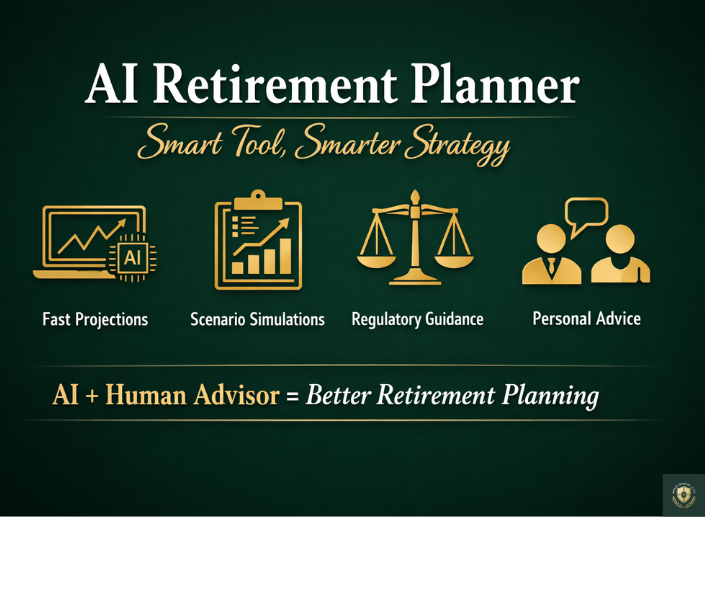
Today’s retirement landscape is evolving. AI enables lightning-fast simulations and personalized projections that can analyze thousands of scenarios in seconds. Yet, despite its promise, AI has limitations; it cannot replace human judgment, regulatory oversight, or deep personal insight. The future of retirement planning is not AI or human advisors—it’s AI + licensed financial professionals working together to deliver smarter, more reliable outcomes.
In this post, we’ll explore what AI retirement planners are, where they excel, where they fall short, and why the combination of AI technology and human expertise produces the strongest strategy for retirement success.
An AI retirement planner is a software system that uses artificial intelligence, machine learning, and advanced algorithms to analyze your financial data, estimate your retirement needs, and simulate future scenarios. These platforms use historical data, statistical models, and predictive analytics to calculate things like:
How much you need to save each year to reach your retirement goals
When you can afford to retire based on current savings and projected returns
How different market conditions might affect your portfolio over time
The probability that your plan will succeed under a range of economic scenarios
A growing number of AI-driven retirement platforms offer features such as Monte Carlo simulations, tax impact analysis, Social Security optimization, and personalized recommendations based on your inputs. Some tools even act as conversational “AI coaches,” helping users explore retirement strategies through natural-language interaction.
Example in Practice: Modern AI retirement planners can simulate thousands of market scenarios in seconds to estimate the likelihood your plan will succeed. One platform advertises 5,000 market simulations that evaluate your expected retirement income and success probability.
AI can process complex financial models in a fraction of the time humans require. Traditional planning might take hours of manual data entry and spreadsheet work; AI tools can deliver projections in moments. This speed enables more frequent updates, real-time scenario testing, and rapid comparison of “what-if” questions.
2. Advanced Analytics and Projections
AI excels at pattern recognition and large-scale data analysis. Using machine learning, it can spot trends and correlations a human might miss. For retirement planning, this means more precise forecasts of savings needs, investment outcomes, and risk exposure. Tools incorporating AI generally use advanced simulations, like Monte Carlo models, to illustrate the range of potential futures and the likelihood of plan success. retireplanai.com
3. Personalization at Scale
While early retirement tools offered generic benchmarks (e.g., “Save 15 percent of your income”), AI can tailor recommendations to your specific financial profile—income, age, risk tolerance, expenses, tax status, and retirement goals. Retirees with smaller accounts now have access to personalized guidance that was once the exclusive domain of high-net-worth clients.
4. Cost Reduction and Accessibility
Traditional financial advisors often charge between 1% and 2% of assets under management (AUM). AI-powered platforms, including “robo-advisors,” typically charge lower fees (often 0.25% to 0.50% of AUM), making guidance more accessible to individuals with modest portfolios. Safe Money Lady
Despite these strengths, AI is not a complete substitute for human retirement planning. There are significant limitations that anyone using AI tools should understand.
AI processes data; it doesn’t understand human values, personal preferences, or emotions the way a human advisor does. Retirement decisions are deeply personal and involve goals that go beyond numbers—family considerations, lifestyle choices, legacy planning, and emotional comfort with risk. AI cannot intuit these subtleties without human input.
For example, a 62-year-old planning to retire in five years might receive a clean projection from an AI tool based on standard assumptions. But that tool won’t inherently know about a history of longevity in the family or upcoming healthcare needs—factors a human advisor would proactively explore. Meenes Wealth Partners
2. Potential for Inaccurate or Incomplete Outputs
AI relies on the quality and completeness of the data it receives. If you provide incomplete information—or if the underlying model uses outdated or biased data—the output can be misleading. Some AI systems have even been known to produce confident but incorrect information, particularly in areas like tax rules or long-term projections, where assumptions matter deeply. Benzinga
consult a local financial professional
3. Lack of Regulatory Oversight and Fiduciary Duty
Licensed financial advisors operate under regulatory frameworks and fiduciary standards designed to protect clients. They must adhere to laws governing suitability, disclosure, and ethical conduct. AI tools, by contrast, have no regulatory accountability, meaning they may present recommendations without considering compliance or legal implications. Investopedia
Retirement planning isn’t purely analytical; it’s psychological. Investors often make poor decisions during market stress, panic selling at the bottom or holding too tightly during rallies. Human advisors help manage this behavior, providing reassurance and perspective that AI cannot. Surveys show that while many people are comfortable using AI for planning, the majority still trust human insight over AI alone. Benzinga
Why the Hybrid Model Works Best
The ideal retirement planning approach today is not “AI versus human advisors”—it’s AI plus human advisors.
1. Combining Computational Power and Human Insight
AI can sift through enormous datasets, run thousands of projections, and generate personalized insights faster than any human. A licensed advisor then interprets those outputs, adjusting them based on life context and legal frameworks.
For example, AI might show that a particular asset allocation has a 90% probability of achieving your retirement income goals over 30 years. A human advisor might then adjust that allocation for tax efficiency, risk tolerance, or upcoming life events. Together, they produce a strategy that is both data-informed and personally tailored.
2. Better Risk Management and Compliance
AI can highlight risks you might not see—but it can’t enforce regulatory compliance. Advisors ensure that recommended strategies meet legal standards and fiduciary responsibilities, reducing the chance of costly mistakes. RetirementAdvisorPro
Life changes: jobs, health, family commitments, inheritance, taxes, and market regimes all evolve. AI tools can update projections, but they cannot proactively interpret new life stages unless prompted. Human advisors anticipate and adapt plans before issues become problems. Northstar Financial Planners
4. Emotional Support and Decision Confidence
Retirement planning decisions often involve fear of outliving savings, market volatility, and timing questions that have emotional weight. Human advisors provide psychological support and counsel, helping clients stay committed to long-term strategies.
Real-World Adoption and Trends
AI adoption in retirement planning is growing quickly. Surveys indicate that a significant portion of advisory firms are integrating AI tools to enhance their services. Estimates suggest that:
45% of retirement planning firms have already integrated AI tools into their advisory services.
60% plan to adopt AI technology within the next two years.
AI-driven tools improve portfolio optimization accuracy by approximately 25%.
AI solutions reduce onboarding time and increase client satisfaction.WifiTalents
Consumers also show increasing comfort with AI. More than half of respondents in some studies express trust in AI assistance for financial planning, though many still prefer human oversight. Nasdaq
Best Practices for Using AI Retirement Planners
If you’re considering AI for your retirement planning, here’s how to use it effectively:
1. Treat AI as a Decision-Support Tool
Use AI to generate scenarios, estimate retirement needs, and explore options—but not as the sole decision-maker. Always validate AI outputs with a human expert or additional research.
AI tools only perform as well as the data they receive. Providing complete financial information, including tax status, risk tolerance, expenses, and long-term goals, improves output quality.
3. Look for Tools with Transparency and Security
Choose platforms that clearly explain their methods and protect your data with strong security protocols.
4. Partner with a Licensed Advisor
Integrate AI outputs with professional advice. A licensed financial advisor adds context, ensures compliance, and helps interpret results in the context of broader life goals.
Conclusion: The Smartest Retirement Strategy in 2026
AI retirement planners are not merely futuristic novelties; they are powerful analytical engines that enhance speed, precision, and personalization in retirement planning. AI systems can test thousands of scenarios in seconds, tailor plans to individual financial profiles, and surface insights that would take humans much longer to generate. Encyclopedia Britannica
However, AI is not a standalone solution. It lacks emotional intelligence, regulatory accountability, and the deep personal context that licensed financial professionals provide. Relying on AI alone can lead to incomplete or inaccurate planning, misinterpretation of results, and potentially costly errors. Meenes Wealth Partners
The future of retirement planning is not a choice between AI and human advisors. It’s the synergy of both—AI’s computational power plus a licensed professional’s judgement. Together, they deliver smarter strategies, better risk management, and greater confidence as you approach one of life’s most important milestones.
If you want to leverage AI to inform your retirement decisions while also benefiting from personalized guidance, the hybrid approach is the most reliable, comprehensive, and future-ready strategy available today.
Education builds clarity. Personalized planning provides direction.
If you want to understand how these strategies apply to your financial goals,
a thoughtful review can help you move forward with confidence.